
Ingesting the World: Cannibalism as an Identity-Forming Process
Mouth

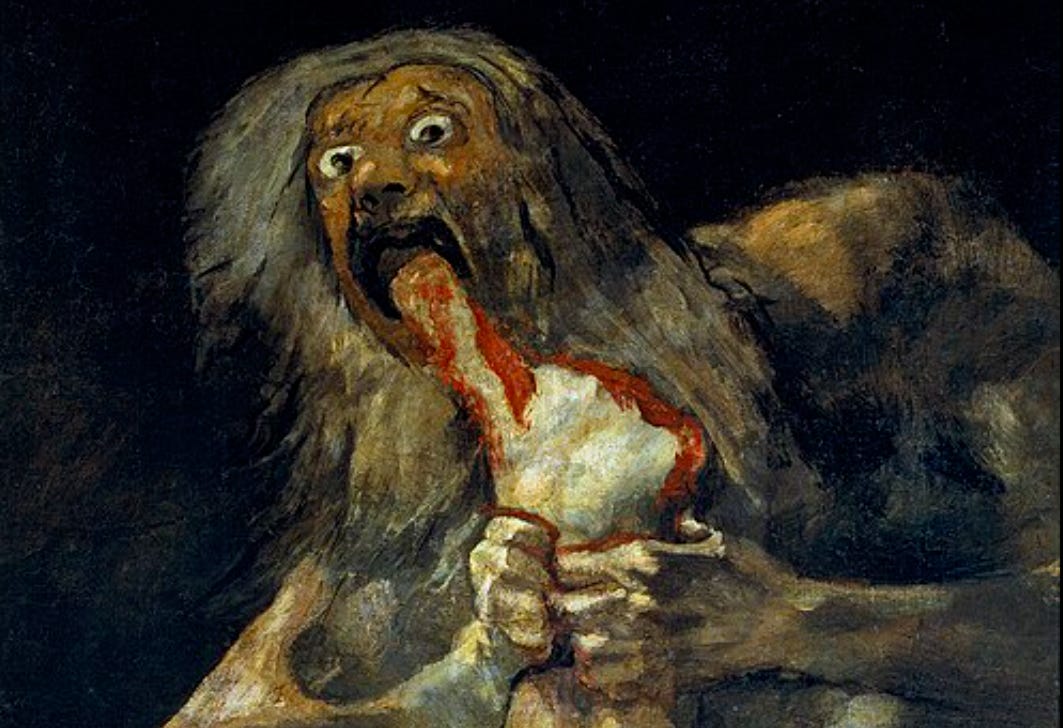
Cannibalism, at its most literal, is the act of eating one’s own kind. It sits at the margins of what cultures openly acknowledge, and yet it resurfaces with surprising persistence: in myth, in medicine, or ritual leftovers that still hold the outline of older worlds. What poses as the final limit of transgression seems to function as something else entirely: an early, almost intuitive way of dealing with the foreign or threatening. The act itself begins to echoe identity-building patterns: cannibalistic incorporation creates identification.
Freud understood this dynamic long before anyone tried to explain the literal practice. In his account, the psyche has a habit of “eating” what it cannot control. When an object becomes too charged or too strange, the ego’s reflex is to draw it inward. Incorporation becomes a tactic: break down what you cannot face directly, dismantle it from the inside. It is not a subtle process, but he believed it worked: if you cannot master something at a distance, bring it closer and metabolize it.
Kristeva pushes this structure further. Her notion of the abject describes whatever the self tries to expel but never quite succeeds in shaking off. It sits at the threshold, half-returning, half-rejected. And here too, ingestion becomes the operative grammar: what is not metabolized resurfaces. Unassimilated matter, psychic or literal, continues to act up. Identity forms as much from what we failed to eject as from what we consciously chose.
This uneasy movement of expelling, yet ingesting, drawing in what one also wants to refuse, sits at the core of how selves take shape. The mouth becomes the earliest site for this boundary-work: it decides, long before language, what crosses into the interior.
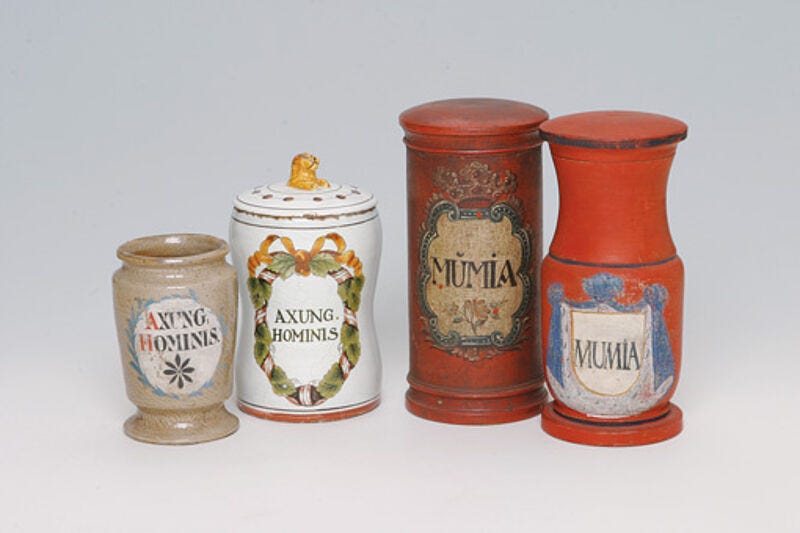
My own interest in sacred cannibalism took root not in grand mythologies, but in a phenomenon much smaller and possibly stranger: early-modern mummia, powdered human remains sold across XVIII-century pharmacies as medicine, a panaceum, in fact. At first it seemed like a harmless historical curiosity, mildly grotesque and morbid, but too distant to provoke anything more than a raised eyebrow. However, the gesture lodged itself in my mind. A physical substance joined with a metaphysical expectation -the belief that consuming fragments of another body could repair one’s own. Oddly practical, oddly magical (it did resemble sympathetic magic). Incorporation became literal: a body ingested to heal a body. Matter crossing a boundary and carrying meaning with it. After that, I couldn’t ignore the emerging pattern anymore.
To no surprise, the ritual of Eucharist entered the picture. In communion, the mouth becomes a liturgical threshold where matter and the divine briefly coexist. Bread and wine are taken as body and blood; eating carries the symbolic weight of union. One receives God the same way one receives nourishment. The line between sustaining the body and sustaining the soul thins almost to transparency. It suggests that approaching the infinite may rely less on abstraction and more on the simple act of swallowing. Eating what one hopes to become is undeniably strange. Yet it appears everywhere, in different symbolic disguises. Desire plays a role, but so does surrender: a willingness to be altered from the inside. The mouth becomes the crossing point where matter drags meaning with it.
Trying to understand further how mouth became such a potent site of transformation led me back to thinking about infancy. Before language or categories, infants test (or taste?) the world with their mouths. Texture, temperature: everything is first known through contact. This is not just sensory play; it marks the beginning of differentiation. Freud’s account of the infant discovering that the mother is separate begins here, with the mouth as the first boundary capable of making a distinction. The division between self and OTHER is bodily first, conceptual later.
The gesture of incorporation continues to fascinate me with its poetic and creative potential, and how many different levels it works on. It’s logic does not stop at religion or psychoanalysis. It resurfaces again in modern cultural movements.
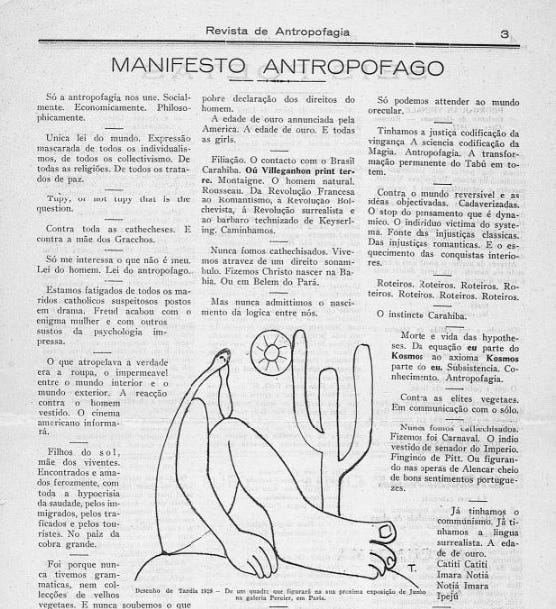
The Tropicália artists of the 1960s didn’t treat Oswald de Andrade’s Manifesto Antropófago (1928) as just some museum piece. They used it like a tool. Andrade’s point was simple and strange enough to work: Brazil’s real strength is its ability to swallow foreign influence and turn it into something new. “Cannibalism,” for him, wasn’t violence at all but a kind of cultural metabolism. Caetano Veloso, Gilberto Gil, Hélio Oiticica and the rest followed this line of thinking without much ceremony. They took in European forms, chewed through them, and handed back something that didn’t resemble the original source. Consuming the dominant culture wasn’t imitation; it was the quickest route to undoing it. In their hands, cannibalism becomes less a metaphor and more a practice—a way of working with the world by taking it apart from the inside.
Seen from here, cannibalism starts to look like a method of keeping homeostasis, almost a biological reflex. Take in what unsettles you, let it settle somewhere inside, and adjust. This motion of pulling the outside world inward to keep the self intact might explain why incorporation shows up so often, whether we’re talking about psychology, ritual, or culture. The formative gesture which appears early in human life and simply never leaves us, guarding our coherence, and stirring the process of becoming.